
At Victoria Therapy Centre, therapist, Sam Keeley is now offering cognitive assessments for young people (aged 6-17).
This form of assessment is used to measure a person’s cognitive capabilities — how they think, learn, remember, and solve problems. These assessments provide insight into how the brain is functioning in different areas of cognition and are commonly used in educational, clinical, and developmental contexts.
A cognitive assessment can be invaluable for parents/carers, schools, other professionals and local authorities in gaining a deeper understanding of your young person’s thinking processes and their perception of the world. This assessment provides insights into various aspects of your young person’s cognitive abilities, including their capacity to process verbal and visual information, approach problem-solving, the speed at which they process information, and their short-term memory retention. By using this information, your child’s learning journey can be supported in a tailored way.
An assessment is about understanding how someone learns and thinks, so appropriate support, instruction, or intervention can be provided.
It can be very powerful as a complimentary part of an Autism or ADHD assessment because it can highlight peaks and troughs in intellectual capability. We also know that neurodivergent children are more likely to have ‘uneven cognitive profiles’, learning difficulties, and/or learning disability, compared to neurotypical children and young people. A cognitive assessment can be useful to help identify the unique learning profiles of all individuals, leading to tailored and more effective support.
The type of cognitive assessment used is called the The Wechsler Intelligence Scales for Children (WISC-5). It is seen as a gold standard of cognitive assessment and is an accepted form of assessment by local authorities, for example within education, health and care (EHC) needs assessments.
Although this assessment does not provide a diagnosis of learning disability/intellectual disability, it is one of the components required for such a diagnosis, if this is indicated.
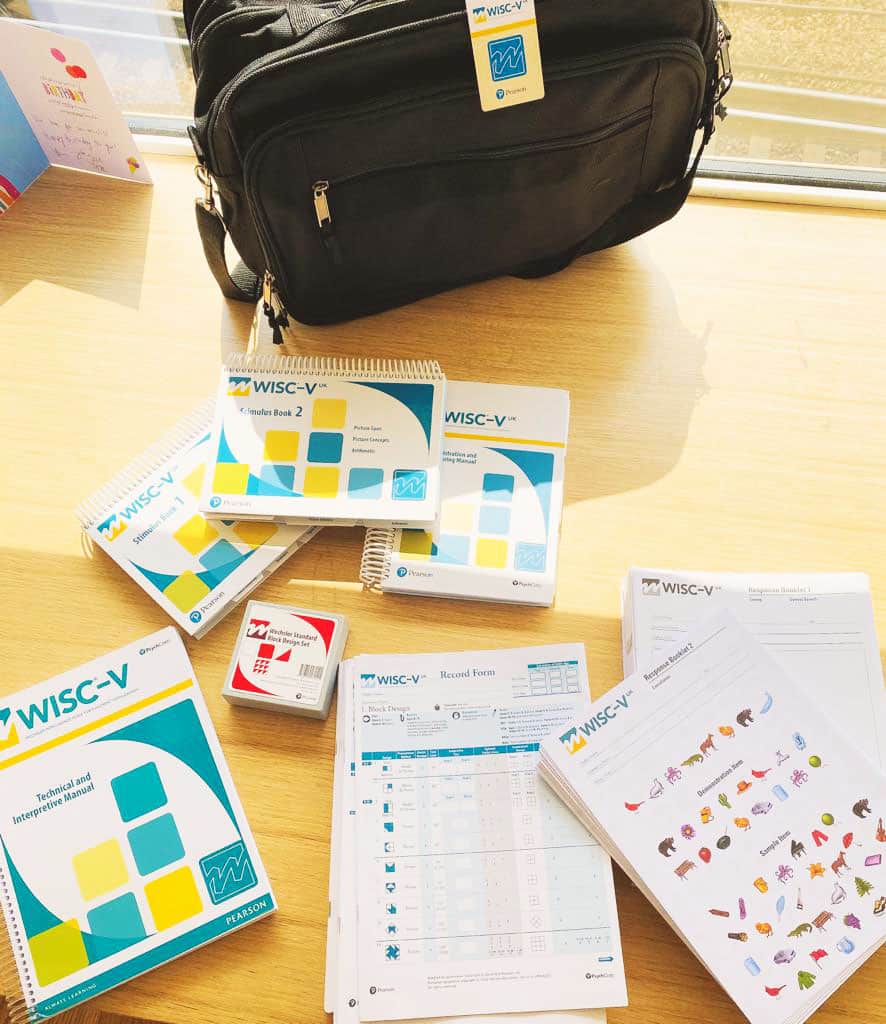

Initial discussions will be held with parents/carers and the young person’s school to discuss the their needs and presentations.
An assessment session will then be undertaken in person. This consists of a series of brief puzzles, questions and tasks using paper and pencil as well as a specialised set of tools. The process typically takes up to two hours.
A period of time is then spent analysing the scores. The scores are compared to age-based norms and are interpreted in context — identifying patterns and ruling out alternative explanations. These outcomes are then compiled into a report which includes results and recommendations.
A feedback session is held with the client/family to review, explain and discuss the outcomes and the report.
The WISC V (Wechsler Intelligence Scale for Children – Fifth UK Edition) is used. This is designed for children and young people aged 6 – 17. It is considered the gold standard for child cognitive assessment because it is based on extensive clinical research.
The WISC-V is used to measure the general thinking and reasoning skills of children. It consists of 10 tasks that each measure skills associated with an area of intellectual functioning. WISC-V scores show how a child has performed compared to a group of children of their age from the United Kingdom.
In addition to scores from individual tasks, the assessment provides further scores that represent a child’s overall intellectual ability (this is known as a full-scale IQ score) as well as scores for verbal comprehension, visual spatial processing, fluid reasoning, working memory, and processing speed.
£700 for private individuals.
£1000 for local authorities and residential care services.
For more information on Cognitive Assessments, please contact Sam Keeley directly by emailing sam@victoriatherapycentre.co.uk or calling/texting 07471 452379.
© 2023 Victoria Therapy Centre. All rights reserved.